Bushfire season prep in Perth usually comes down to clearing the fuel load around your home before the hot, dry months hit. The safest and most cost-effective approach for most homeowners is to hire the heavy-duty tools you’ll only need once or twice a year—a chainsaw for fallen limbs and storm debris, a brush cutter for long grass and scrub, and a trailer to haul the green waste away—rather than buying them outright. DFES advises using the milder spring conditions to remove dead vegetation, clear gutters, and prune trees away from structures before summer arrives.
This guide covers what WA authorities expect from property owners, which equipment matches each clearing job, a step-by-step prep plan, and the legal checks you need to make before you cut anything.
What WA Authorities Expect from Property Owners
The Department of Fire and Emergency Services (DFES) runs the annual Burn SMART campaign, urging residents in bushfire-prone areas to prepare properties before the southern bushfire season. Over 90% of Western Australia is classified as bushfire prone, and the peak risk period runs roughly from October through April.
DFES specifically encourages residents to take these steps in the lead-up to summer:
- Conduct planned burns while conditions are mild (and register them with DFES).
- Remove dead vegetation and clear gutters and undergrowth.
- Choose fire-resistant plants and use non-combustible materials around the home.
- Keep trees pruned well away from structures.
DFES also promotes “firewise gardening”—a strategic approach to landscaping that creates defensible space around the home. The Commissioner notes that homes are exposed to fire through embers, radiant heat, and direct flame contact, and the way you design and maintain your garden can make a critical difference.
The 20-Metre Circle of Safety
Local council guidance across WA commonly references a recommended 20-metre circle of safety around the home, maintained by clearing away trees, dead leaves, twigs, and branches, and cutting long grass and undergrowth within that zone. Some shires specify cutting long grass to a height of 5 cm and pruning lower branches up to 2 metres off the ground to stop a ground fire spreading into the tree canopy.
Check Your Local Council’s Firebreak Rules
Firebreak requirements vary by council and property zoning. Some Perth councils have brought firebreak installation deadlines forward to October 31 for rural and rural residential properties, with inspections starting mid-October. Check your local council’s website or call them directly to confirm your obligations, as penalties can apply for non-compliance.
Also Check: Hiring Tools vs Calling a Tradie: When Does DIY Actually Save You Money in Perth?
Before You Cut: Native Vegetation Clearing Rules in WA
This is the step most homeowners skip, and it can be costly. All clearing of native vegetation in WA requires a permit from the Department of Water and Environmental Regulation (DWER) unless the proposed clearing falls within a specific exemption category.
Exemptions can include clearing for an immediate threat to life or property, establishing a property fence line, or works required under an annual Bushfire Mitigation Notice from your local government. However, a permit is always required within designated environmentally sensitive areas, along waterways, or where threatened flora or fauna habitat has been mapped.
Non-native vegetation generally does not require approval to clear unless it sits within an environmentally sensitive area. If you’re unsure, lodge a referral with DWER before you start cutting.
For most suburban Quinns Rocks properties, the practical takeaway is: clear the weeds, long grass, and dead material freely, but check before removing native trees or large shrubs.
Bushfire Prep Equipment Checklist
| Area / Job | What Needs Doing | Equipment to Hire |
|---|---|---|
| Fallen branches and storm debris | Cut up timber for removal or disposal | Chainsaw |
| Long grass and paddocks | Slash down overgrowth to reduce fuel load | Brush cutter |
| Overgrown shrubs | Prune back vegetation close to walls and windows | Hedge trimmer or hand tools |
| Green waste and cleared material | Haul to tip or green waste facility | Trailer |
| General yard cleanup | Rake, bag, and load debris | Hand tools, wheelbarrow |
Chainsaw Hire for Fallen Limbs and Storm Debris
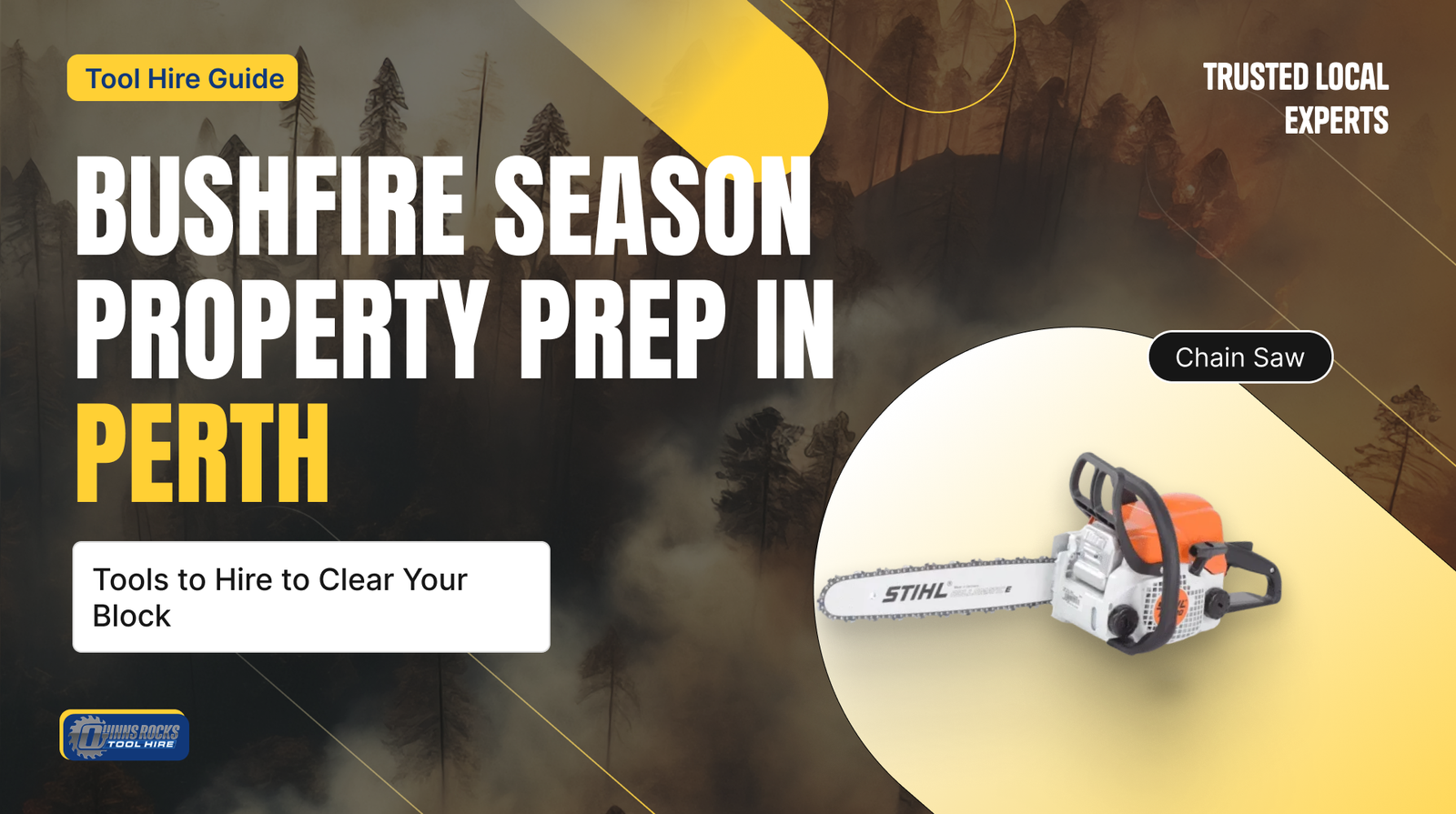
A chainsaw is the workhorse of bushfire prep. Storm-damaged branches, fallen timber, and overgrown trees all need cutting down to a size you can move and dispose of. Quinns Rocks Tool Hire stocks the Stihl MS 180 chainsaw, a 31.8cc, 1.5kW machine with a 16-inch (40cm) bar—sized appropriately for homeowner-level clearing work rather than commercial logging.
Browse our chainsaw range on the Quinns Rocks Tool Hire website to check availability for your dates.
Chainsaw Safety Basics
Chainsaws are the highest-risk tool in this list. Before you start:
- Wear chainsaw chaps, eye protection, hearing protection, and sturdy boots.
- Never cut above shoulder height.
- Clear the area of people and pets before starting the saw.
- Watch for kickback—keep the bar tip clear of other objects.
- Switch off and let the chain stop before moving between cuts.
If you’re not confident with a chainsaw, ask the hire team for a demonstration at handover.
Also Check: Safety Tips for Using Hired Power Tools: 10 Must-Know Rules
Brush Cutters for Long Grass and Scrub
Long dry grass is one of the fastest-moving fuel sources in a bushfire. DFES and local council guidance consistently emphasise cutting grass and undergrowth as a core preparation task. A brush cutter handles edges, fence lines, and areas a mower can’t reach.
Our Stihl BS131 whipper snipper is built for clearing overgrown grass and thick scrub, with a bike handle and shoulder strap for control on rough ground. It’s the right tool for knocking down long grass along fence lines and around sheds before the fuel load builds up.
Check with the hire team about the right cutting head for your job—nylon line for light grass and weeds, metal blades for heavier brush.
Trailer Hire for Green Waste Removal
All that cut vegetation has to go somewhere. A trailer lets you clear the lot in one or two trips rather than stuffing bags into the boot. See our trailer hire guide for towing capacity, towbar compatibility, and load restraint advice before you book.
Before you load:
- Check your towing set-up. Confirm your vehicle’s towing capacity, towbar, and wiring connector.
- Check your council’s green waste options. The City of Wanneroo, for example, offers eligible residents up to four free clean green waste drop-offs per year at the Wangara Recycling Facility with a valid voucher, and requires green waste to be covered during transport to prevent the spread of polyphagous shot-hole borer. Fees apply without a voucher.
- Know the restrictions. Branches typically must be under a certain length (1.5 metres at Wangara), and soil, rocks, and building materials are refused.
Also Check: Daily vs Weekly Hire
Your Bushfire Prep Timeline
September–October (before the heat):
- Check your council’s firebreak deadline and requirements.
- Confirm what native vegetation you can and cannot clear (contact DWER if unsure).
- Walk your property and list jobs: fallen timber, long grass, overhanging branches, gutters.
- Book equipment for a block of days when you can get the work done.
On the day(s):
5. Start with the highest-risk fuel: long dry grass near the house, then fallen branches and dead material.
6. Prune lower branches and clear vegetation away from walls, windows, and the roof line.
7. Clear gutters and roof valleys.
8. Load green waste and take it to your council facility or arrange a bulk verge collection if available.
After clearing:
9. Photograph the cleared areas as evidence of compliance if your council requires it.
10. Check hoses and firefighting equipment are in working order.
Safety Tips for Bushfire Prep Work
- Wear closed shoes, long trousers, eye protection, and hearing protection when using power tools.
- Never operate a chainsaw or brush cutter alone in a remote area—have someone check on you.
- Be aware of overhead power lines before cutting tall branches.
- Hydrate and take breaks—clearing work is physical and often done in warming weather.
- Keep a phone charged and nearby in case of emergency.
- Check fire danger ratings before starting any work that could generate sparks (such as chainsaws or metal blades on dry grass).
Common Bushfire Prep Mistakes
- Cutting native vegetation without checking. Fines for illegal clearing can far exceed the cost of hiring a professional or getting a permit.
- Leaving it until the first hot week. DFES explicitly recommends using mild spring conditions. Rushing in the heat increases risk of injury and heat stress.
- Focusing only on the garden and forgetting gutters. Embers landing in leaf-filled gutters are a common ignition point.
- Not covering green waste during transport. This is a requirement in some councils and helps prevent pest spread.
- Ignoring the trailer’s load limit. Overloaded trailers are dangerous and can damage your vehicle.
- Forgetting to check the firebreak deadline. Some Perth councils now require compliance by October 31, not November.
What to Check Before You Book Bushfire Prep Equipment
Have these ready when you contact the hire team:
- Your property size and the type of clearing needed (grass, branches, shrubs, or all three)
- Whether you need a chainsaw, brush cutter, or both
- How much green waste you’ll generate (to size the trailer)
- Your vehicle’s towing capacity if hiring a trailer
- Your council’s green waste drop-off rules and whether you have a voucher
- Your availability—book early if you’re clearing on a weekend
Why Hire From Quinns Rocks Tool Hire
Quinns Rocks Tool Hire has supported Perth’s northern suburbs for over 19 years, including Quinns Rocks, Mindarie, Alkimos, Butler, and Clarkson. Our team can match you with the right chainsaw, brush cutter, or trailer for your block, and walk you through safe operation at handover.
See everything we hire on our homepage.
Frequently Asked Questions
1. Do I need a permit to clear vegetation around my home for bushfire prep?
It depends on the vegetation type and location. Clearing non-native vegetation generally does not require approval unless it’s in an environmentally sensitive area. Native vegetation clearing requires a DWER permit unless an exemption applies, such as works under a Bushfire Mitigation Notice. Contact DWER or your local council if unsure.
2. When should I start preparing my property for bushfire season in Perth?
DFES recommends using mild spring conditions (roughly September–October) to conduct planned burns and clear vegetation before the heat of summer. Some councils require firebreaks installed by October 31.
3. What size chainsaw do I need for clearing fallen branches?
A homeowner-sized saw like the Stihl MS 180 (31.8cc, 16-inch bar) is suitable for cutting fallen limbs and small trees. Larger trees or heavy storm damage may require a bigger saw—ask the hire team to match the machine to your job.
4. Can I put green waste in my regular bin?
Green waste should go to a council green waste facility or bulk verge collection, not your general rubbish bin. The City of Wanneroo offers eligible residents free green waste drop-offs with a voucher, and requires loads to be covered during transport.
5. How far ahead should I book equipment for bushfire prep?
Book at least a week ahead, especially if you’re clearing on a weekend or during peak spring preparation season. Contact the team to confirm availability for your dates.
6. Where can I hire bushfire prep equipment near me in Quinns Rocks?
Quinns Rocks Tool Hire is based in Quinns Rocks and services Perth’s northern suburbs. Contact the team to check availability and book.
Final Thoughts
Bushfire prep is mostly about fuel reduction: cut the grass, clear the dead material, prune what’s close to the house, and get the green waste off your block. A chainsaw, brush cutter, and trailer cover the heavy work for a fraction of the cost of buying them. Check your council’s firebreak rules and WA’s native vegetation clearing requirements first, then book early and give yourself a weekend to get it done.
Ready to book? Get in touch through our contact page and our team will help you choose the right equipment for your property.