What size generator do you need? Add up the running watts of everything you’ll power, allow extra for motors that surge when they start, then add about 20% headroom. For most tool, small event and outage jobs, that lands somewhere between 1kW and 3kW. Go too small and the generator overloads and cuts out. Go too big and you pay to move and fuel a machine you don’t need.
If you’re comparing generator hire in Perth, this guide shows you how to size one in three steps, what a 3.5kVA inverter generator can and can’t run, how to plan for tools, events and power outages, and how to use a generator safely.
Generator Sizing in 3 Simple Steps
Step 1: List Everything You’ll Run and Its Watts
Write down every item you plan to run at the same time. The wattage is on the rating label, usually near the power cord or on the back. If it only lists amps, multiply amps by 240 to get watts.
Step 2: Allow for Starting Surge
Motors and compressors draw several times their running power for a moment when they start. Fridges, air compressors, pumps, air conditioners and many power tools all do this. Your generator has to handle the biggest surge on top of everything already running.
Step 3: Add 20% Headroom and Compare
Add up the watts you’ll run together, include the largest surge, then add roughly 20%. A generator should run comfortably below its limit, not at it. Compare your total to the generator’s continuous output, not its peak rating.
Watts, VA and kVA: What the Numbers Mean
Watts measure real power, which is what your appliances use. Volt-amperes (VA) and kVA are the generator’s rating, and for small generators the usable watts are a little lower than the kVA figure. That’s why a “3.5kVA” generator doesn’t give you 3,500W of usable power.
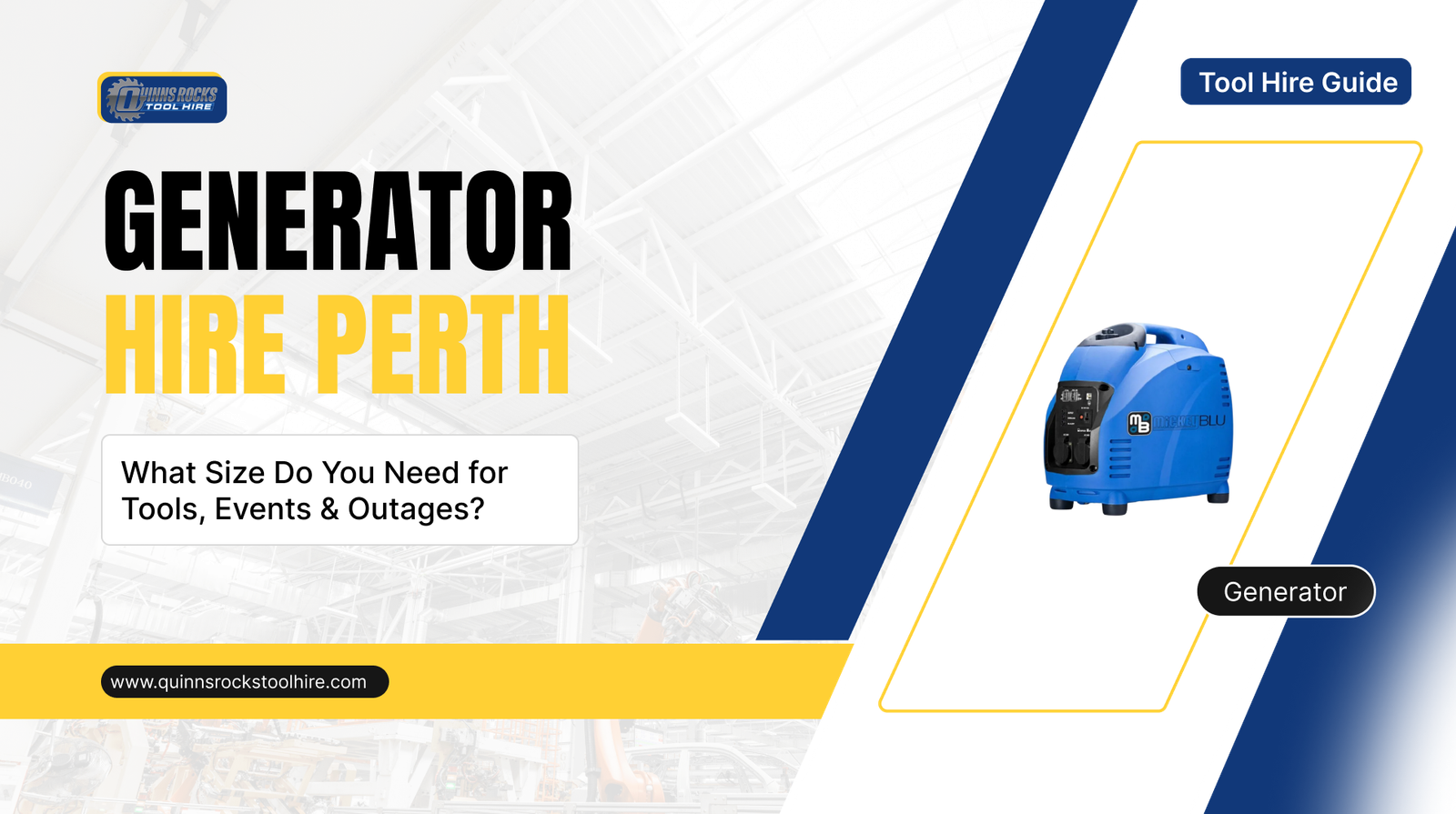
Our listed hire generator is a 3.5kVA inverter unit with a stated maximum constant output of 3,200W, so plan around the watts figure, not the kVA.
Typical Power Use of Common Items
These are typical ranges only. Always check the label on your own equipment.
| Item | Typical Running Watts | Starting Surge? |
|---|---|---|
| LED work light | 10 to 100W | No |
| Phone or laptop charging | 5 to 100W | No |
| Wi-Fi router | 10 to 20W | No |
| TV | 50 to 200W | No |
| Fridge or freezer | 100 to 250W | Yes, several times running watts |
| Microwave | 1,000 to 1,500W | Moderate |
| Kettle | 1,800 to 2,400W | No |
| Electric hotplate (per element) | 1,000 to 2,000W | No |
| Coffee machine | 1,200 to 2,000W | No |
| PA speaker system | 100 to 500W | No |
| Drill | 500 to 1,000W | Moderate |
| Circular saw | 1,200 to 1,800W | Moderate |
| 125mm angle grinder | 700 to 1,200W | Moderate |
| Electric pressure washer | 1,400 to 2,500W | Yes |
| Air compressor | 1,000 to 2,500W | High |
| Demolition hammer | About 1,700W | Yes |
| Split-system air conditioner | 1,000 to 3,000W | Yes |
Also Check: Top Construction Equipment You Can Rent Instead of Buy in WA
What Can a 3.5kVA Inverter Generator Run?
Our 3.5kVA silent inverter generator is listed with these specs:
- Maximum constant AC output: 3,200W
- 240V output with a double 10/15 amp AC outlet
- 12V DC output at 8A
- Pure sine wave inverter, safe for electronics
- Noise of 57dB at 5m, depending on load
- Weight of 28kg
- Daily or weekly hire
As a rule, run the generator at no more than 80% of its constant output, which is about 2,500W. That’s enough for:
- A circular saw or grinder plus work lights
- A drill and battery chargers
- Lighting, speakers and phone charging for a small gathering
- A fridge, freezer, lights, router and chargers during an outage
It’s not the right machine for several large loads at once, three-phase equipment, welders, big air conditioners, ovens or powering a whole house.
Worked Examples
Example 1: Tools on a Job Site
A circular saw (1,500W), two LED work lights (100W) and a phone charger (20W). If you run one tool at a time, the total is about 1,620W. That’s well within 2,500W.
Example 2: A Small Event
PA speakers (300W), LED lighting (500W) and a coffee machine (1,800W) come to 2,600W. That’s slightly over the 80% line, so run the coffee machine on its own circuit, stagger the load, or use a second generator.
Example 3: Outage Essentials
A fridge (200W running), freezer (200W), LED lights (100W), router (20W), TV (150W) and phone chargers (50W) total about 720W running. Add a fridge start surge of perhaps 800W to 1,000W and you’re still under 2,500W.
Example 4: Jackhammer Hire
A 1,700W demolition hammer uses more than half of this generator’s output before the starting surge. Check with our team before running a demolition hammer off a generator, because mains power may be the safer option.
Sizing a Generator for Tools
Power tools are the most common reason to hire a generator in Perth, especially on new builds, rural blocks and renovation sites with no power connected.
- Run one big tool at a time. Two high-draw tools together is where most overloads happen.
- Check the nameplate. Look at the watts of your biggest tool and add the other loads on top.
- Remember surge. Saws, grinders, compressors and pressure washers pull more when they start.
- Consider cordless. Cordless tools can cut how much power you need, and our Milwaukee cordless range may avoid the need for a generator altogether.
Also Check: Safety Tips for Using Hired Power Tools: 10 Must-Know Rules
Sizing a Generator for Events
For a backyard party, market stall or small gathering, count lighting, sound, charging and anything that heats.
- Lighting: LED lights use little power, so they barely register.
- Sound: A PA system can run from a few hundred watts.
- Heating: Kettles, coffee machines, urns and hotplates are the big loads. A single one can use most of the generator.
- Noise: An inverter generator is much quieter than a conventional one. Our unit is listed at 57dB at 5m, depending on load. Position it away from guests and neighbours.
- Rules: For public events, check local government requirements for electrical safety and noise.
Sizing a Generator for Power Outages
During a blackout, you don’t need to run everything. List your essentials: the fridge and freezer, a few lights, the router, phone chargers and perhaps a TV or fan. That usually fits a 3.5kVA inverter generator comfortably.
What a portable generator can’t do is run your whole house, a hardwired air conditioner, a ducted heater, an electric hot water system or an oven. Plug appliances straight into the generator using a heavy-duty lead.
Never plug a generator into a wall socket or connect it to your home wiring. WA’s Building and Energy division explains that to power a house or office installation you must have a changeover switch installed by a licensed electrical contractor, and that feeding power back into the network endangers neighbours and tradespeople. Read the WA safe use of portable generators information sheet before you start.
Also Check: Tool Hire Near Me: Best Options in Quinns Rocks
Inverter or Conventional Generator?
| Factor | Inverter Generator | Conventional Generator |
|---|---|---|
| Power quality | Clean, stable power for electronics | Less stable, can stress sensitive devices |
| Noise | Quieter | Louder |
| Fuel use | Adjusts engine speed to load | Runs at constant speed |
| Weight | Often lighter for the output | Often heavier |
| Best for | Events, outages, electronics, camping | Heavy site loads and large outputs |
Our listed generator uses a pure sine wave inverter, which is why it suits laptops, routers and phones as well as tools.
Generator Safety Rules
Generators cause real injuries and deaths each year, mostly from carbon monoxide and electric shock.
- Run it outdoors only. Never operate a generator in a garage, shed, tent, caravan awning or any enclosed space. Petrol generators produce toxic carbon monoxide, and open doors or windows are not enough.
- Keep it away from openings. Place it well away from windows, doors and vents so fumes can’t drift inside.
- Keep it dry and level. Put it on stable, level ground, sheltered from rain with open sides for airflow.
- Never backfeed. Don’t plug it into a wall outlet or your switchboard.
- Use proper leads. Use heavy-duty, undamaged leads, fully uncoiled, and don’t overload power boards.
- Consider an RCD. A portable RCD (safety switch) adds protection against electric shock.
- Refuel safely. Switch it off and let it cool before refuelling, keep fuel in an approved container, and keep sparks and flames away.
- Install CO alarms. Working carbon monoxide alarms in occupied spaces nearby add a safety net.
For more safety detail, the WA information sheet is a short, practical read.
Fuel, Run Time and Noise
Run time depends on the tank size and the load, and an inverter generator burns less fuel at a light load. When you book, ask how long a tank lasts at the load you expect, whether it comes fuelled, and what fuel it needs. Take a spare approved fuel container if you’re working all day.
Transport and Handling
Our generator weighs 28kg, which is heavy for one person to lift into a car or ute. Use two hands, bend your knees, and get help. Transport it upright and secured so it can’t tip or leak fuel, and never leave fuel inside a hot, closed vehicle.
How Long Do You Need to Hire a Generator?
A one-day job or event suits daily hire. Longer renovations or storm recovery suit weekly hire. If you need power urgently during an outage, ask about same-day hire.
Also Check: Daily vs Weekly Hire
What to Check Before You Book Generator Hire in Perth
Have these ready when you call so our team can match you with the right setup:
- A list of everything you’ll run and the watts of each
- The biggest item and whether it has a starting surge
- Whether you need it for tools, an event or an outage
- How many hours you’ll run it each day
- Fuel needs and whether it’s included
- Where you’ll place it, and how you’ll transport it
- Whether you need extension leads or a portable RCD
- How long you need it for
Common Generator Hire Mistakes
- Ignoring starting surge. Fridges, compressors and saws pull more at startup.
- Running at the limit. Constant overload shortens the life of the generator and trips it out.
- Using the wrong power source. Plugging into the house is dangerous and illegal without a changeover switch.
- Running it in a garage. Carbon monoxide kills.
- Underestimating heaters and kettles. Heating elements use most of a small generator’s output.
- Skimping on leads. Thin or damaged leads overheat.
- Forgetting fuel. Ask what’s included before you collect.
Generator Hire vs Buying
For occasional use such as a one-off job, event or outage, hiring beats buying. A good inverter generator is a big purchase, needs regular servicing, and the fuel goes stale if it sits. Hiring gives you a serviced machine for the days you need it.
Why Hire a Generator From Quinns Rocks Tool Hire
Quinns Rocks Tool Hire has supported Perth’s northern suburbs with reliable, well-maintained equipment for over 19 years, including Quinns Rocks, Mindarie, Alkimos, Butler and Clarkson. Our team can help you work out how much power you need and which generator suits your job.
Browse our generator hire in Perth range, or see everything else we hire out on our homepage.
Frequently Asked Questions
1. What size generator do I need for power tools?
Add up the watts of the tools you’ll run at the same time, allow for starting surge and add about 20% headroom. Many sites can run one saw or grinder plus lights from a 3.5kVA inverter generator.
2. How many watts does a 3.5kVA generator give?
Our listed 3.5kVA inverter generator has a stated maximum constant output of 3,200W. Plan to use no more than about 80% of that for continuous running.
3. Can a generator run a fridge during a power outage?
Yes. A fridge or freezer draws modest power while running, but allow for the starting surge. A 3.5kVA unit can usually handle a fridge, freezer, lights and a router together.
4. Can I run my whole house on a hired generator?
No. A portable generator can power individual appliances plugged into it. To power house wiring you need a changeover switch installed by a licensed electrical contractor.
5. Can I run an air conditioner on a 3.5kVA generator?
Small units might run, but air conditioners have large starting surges, so check the label and speak to our team before relying on it.
6. Is an inverter generator better than a conventional one?
For events, outages and electronics, yes. Inverter generators are quieter and produce clean power. For heavy site loads, a larger conventional generator may suit better.
7. Where can I find generator hire near me in Quinns Rocks?
Quinns Rocks Tool Hire is based in Quinns Rocks and services Perth’s northern suburbs. Contact our team to check availability and book.
Final Thoughts
Sizing a generator is simple arithmetic: list the loads, allow for surges, and keep 20% in reserve. Match the generator to the job, keep it outdoors, never plug it into your house, and you’ll have safe, reliable power for tools, events and outages.
Ready to book? Get in touch through our contact page and our team will help you choose the right generator for your project.