Grinding vs polishing is a common question for DIY enthusiasts, tradespeople, builders, and renovators across Australia. Whether you are working on concrete floors, metal surfaces, stone benchtops, or automotive parts, understanding the difference between grinding vs polishing is essential for achieving professional results.
At Quinns Rocks Tool Hire, we regularly help customers choose the right tools for grinding and polishing projects. While these processes are often mentioned together, they are not the same—and using the wrong method can lead to poor finishes, wasted time, and unnecessary costs.
This detailed 2025 guide explains everything you need to know about grinding vs polishing, including processes, tools, applications, costs, and when to use each technique.
Introduction to Grinding vs Polishing
Grinding and polishing are both surface preparation and finishing techniques, but they serve very different purposes. Grinding focuses on removing material and correcting surface imperfections, while polishing enhances smoothness and appearance.
In most projects, grinding comes first and polishing follows. Skipping one or confusing the two often leads to unsatisfactory results.
What Is Grinding?
Grinding is a mechanical process that removes material from a surface using coarse abrasives. It is commonly used to level, shape, or clean a surface before further finishing.
Grinding is ideal for:
- Removing rough or uneven surfaces
- Eliminating coatings, adhesives, or rust
- Flattening concrete floors
- Preparing metal or stone for polishing
Grinding is a high-impact process that changes the structure of the surface.
Also Check: Safety Tips for Using Hired Power Tools: 10 Must-Know Rules (2026)
What Is Polishing?
Polishing is a fine finishing process that smooths a surface using finer abrasives or polishing compounds. Unlike grinding, polishing removes very little material and focuses on appearance and surface quality.
Polishing is commonly used to:
- Create a smooth or glossy finish
- Reduce surface friction
- Improve durability and cleanliness
- Enhance visual appeal
Polishing is typically the final stage of surface treatment.
Grinding vs Polishing: Key Differences at a Glance
| Feature | Grinding | Polishing |
|---|---|---|
| Main Purpose | Material removal | Surface enhancement |
| Abrasive Type | Coarse | Fine |
| Surface Finish | Rough to semi-smooth | Smooth to glossy |
| Project Stage | Early or mid-stage | Final stage |
| Skill Level | Moderate to high | Moderate |
Grinding vs Polishing: How Each Process Works
Grinding applies pressure and abrasion to remove layers of material quickly. Polishing uses lighter pressure and finer abrasives to refine the surface gradually.
Grinding corrects problems. Polishing perfects results.
Also Check: The Difference Between Demo Saws and Concrete Saws
Tools Used for Grinding
Grinding typically requires powerful tools designed for heavy material removal, such as:
- Angle grinders
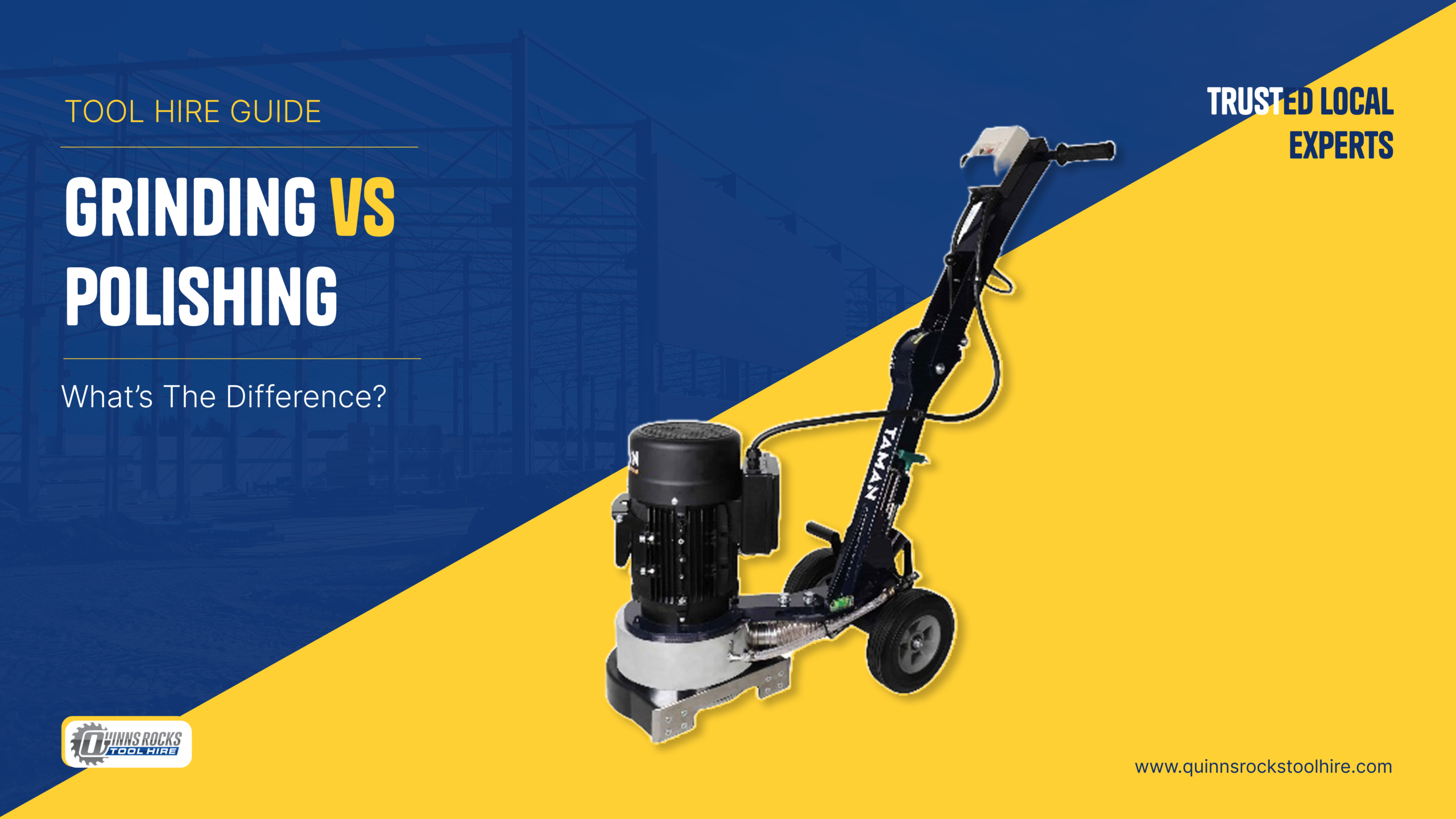
- Concrete floor grinders
- Bench grinders
- Diamond grinding discs
At Quinns Rocks Tool Hire, professional-grade grinding equipment is available for concrete, metal, and stone projects.
Tools Used for Polishing
Polishing tools are designed for control and finesse rather than brute force:
- Variable-speed polishers
- Polishing pads and buffing wheels
- Diamond polishing pads
- Polishing compounds
Using the correct polishing tool ensures a consistent, professional finish.
Grinding vs Polishing for Concrete Floors
Concrete grinding removes surface imperfections, old coatings, and uneven sections. Concrete polishing then transforms the ground surface into a smooth, decorative floor.
Grinding prepares the concrete. Polishing reveals its beauty.
Also Check: The Complete Guide to Grinder Types: Find the Perfect Tool for Your Project in Quinns Rocks
Grinding vs Polishing for Metal Surfaces
Metal grinding removes welds, burrs, and rust. Metal polishing smooths the surface and creates a shiny or brushed finish.
This combination is common in automotive, fabrication, and repair projects.
Grinding vs Polishing for Stone and Marble
Stone grinding corrects uneven tiles and removes scratches. Polishing restores shine and enhances natural patterns.
Marble and granite surfaces require careful polishing to avoid damage.
Grinding vs Polishing for DIY Projects
DIY renovators often underestimate the importance of grinding before polishing. Skipping grinding usually results in visible defects.
Hiring the right tool makes DIY projects faster and more cost-effective.
Also Check: 10 Easy Weekend DIY Projects Using Hired Tools
Surface Finish Comparison
Grinding leaves visible scratches and texture. Polishing removes those marks and creates a refined finish.
The smoother the finish required, the more polishing stages are needed.
Advantages and Disadvantages of Grinding
Advantages
- Fast material removal
- Effective surface correction
- Ideal for tough materials
Disadvantages
- Rough finish
- Generates dust and noise
- Requires safety precautions
Advantages and Disadvantages of Polishing
Advantages
- Superior visual results
- Improves durability
- Reduces surface friction
Disadvantages
Time-consuming
Cannot fix major defects
Requires pre-ground surfaces
When to Use Grinding vs Polishing
Use grinding when:
- Surfaces are uneven or damaged
- Material needs reshaping
Use polishing when:
- Final appearance matters
- A smooth or glossy finish is required
Most professional results use both methods.
Common Mistakes to Avoid
- Polishing without grinding first
- Using the wrong abrasive grit
- Applying too much pressure during polishing
Safety Tips and PPE Requirements
Grinding and polishing require safety gear:
- Eye protection
- Dust masks or respirators
- Hearing protection
- Gloves
Safety should always come first.
Cost and Time Comparison
Grinding is faster but requires more power and wear on tools. Polishing takes longer but delivers premium results.
Tool hire is often the most cost-effective option for short-term projects.
Also Check: Why Quinns Rocks Is the Go-To Choice for Equipment Hire Near Me
FAQs About Grinding vs Polishing
Is grinding the same as polishing?
No. Grinding removes material; polishing refines the surface.
Can polishing remove deep scratches?
No. Deep scratches must be ground out first.
Which process should I do first?
Grinding always comes before polishing.
Final Verdict: Grinding vs Polishing
Grinding vs polishing is not about choosing one over the other—it is about using the right process at the right time. Grinding builds the foundation, while polishing delivers the final professional finish.
For the best results on your next project, make sure you have the right tools for both grinding and polishing. Quinns Rocks Tool Hire can help you choose equipment that saves time, money, and effort in 2026 and beyond.